Mostrando entradas con la etiqueta 2. KINGDOMS. Mostrar todas las entradas

25 de septiembre de 2017

UNIT 1: Kingdoms


ANSWER IN YOUR NOTEBOOK

1. Write True or False.  Circle the wrong word and correct the false sentences.
a)  All bacteria produce diseases. ______
b)  Amoebas belong to the Bacteria Kingdom. ______
c)   Bacteria and yeast are unicellular organisms. _______
d)  Algae belong to the Plant Kingdom. ________
e)  Fungi, like mushrooms, mould and yeast, can make their own food. ________
f)    We can use yeast to make yoghurt. __________
g)  Algae and plants use the light from the Sun to produce their own food.  _________
h)  Animals must eat plants or other animals. _________
2. Read and write the kingdom.

a)    Living things in this kingdom can be unicellular or multicellular. These living things can’t make their own food. they take the nutrients they need from the remains of dead plants and animals. It’s the _____________________ kingdom.

b)    Living things in this kingdom are unicellular. They can live on land, in the air, in water and inside other living things. It’s the _____________________ kingdom.
c)     Living things in this kingdom are multicellular. They can’t make their own food, so they get the nutrients by feeding on other living things. It’s the ______________ kingdom.
d)    Living things in this kingdom are multicellular. They make their own food during the process of photosynthesis. It’s the _____________________ kingdom.
e)    Living things in this kingdom are usually unicellular, but some are multicellular. Some of the living things in this kingdom can produce their own food, but others can’t. It’s the _____________________ kingdom.    

24 de septiembre de 2017

UNIT 1: Bacteria Kingdom


QUESTIONS

1. Are bacteria unicellular or multicellular organisms? Why?
Bacteria are ____________ because _____________________________________

2. Where do bacteria live?
Bacteria can live _____________________________________________________

3. How do bacteria reproduce? How is this type of reproduction called?
Bacteria reproduce by _______________________. This is called _________________ reproduction.

4. How can bacteria be helpful and good? Write two examples.  
________________________________________________________

5. What can harmful bacteria cause?
Harmful bacteria can cause ________________________________

6. Watch this video about bacteria reproduction and complete the information below.
"Bacteria reproduce very simply and rapidly by doubling their contents and splitting in _________ . Just one bacterium dividing every _________ minutes could produce nearly _________ thousand billion billion bacteria in _________ day."


7. Watch this video about the places where bacteria can live. Answer the questions.
a) Name three extreme places on Earth where bacteria can live.

b) What is the difference between washing your hands only with water and washing your hands with water and soap?

c) Is it possible to remove all bacteria from your hands?

23 de septiembre de 2017

UNIT 1: Protist Kingdom


Let's explore protists!

Watch this video about amoebas. What do amoebas like to eat?

Watch these unicellular algae under the microscope. 
Why do algae have chloroplasts?


ACTIVITIES
1.Name two living things that belong to the protist kingdom.
2.Complete the information:
a) Amoebas are ___________ because they only have _____ cell
The amoeba absorbs its food through the ___________.

b)Algae aren’t plants, they belong to the ___________ kingdom.  
They can be unicellular or ______________. 
Algae can make their own food using the light from the _______. 
This process is called _______________.

22 de septiembre de 2017

UNIT 1: Fungi Kingdom


VIDEOS

Watch this video to see some yeast under the microscope.

Let's have a closer look at mould! It looks like a tangle of tiny thin mushrooms!

Is it good to eat the "clean" part of mouldy bread?

Do you want to grow mould at home? Watch this video!

Enjoy this beautiful fungi timelapse!

Did you know that mushrooms are the reproductive organ of fungi? Most of the fungus, the mycelium, is underground. Watch this video to find out!


ACTIVITIES


1. Write three types of fungi, draw and colour them in your notebook.
2. How do fungi obtain their nutrients?
3. What type of fungi is yeast? What is it used for?
4. Where does mould usually grow? 
5. Investigate about these mushrooms. Draw them and circle if they are edible or poisonous
deathcap
(amanita phalloides)
fly agaric
(amanita muscaria)
penny bun
(boletus edulis)
truffle


edible / poisonous
edible / poisonous
edible / poisonous
edible / poisonous

You can use these websites:

20 de septiembre de 2017

UNIT 1: Kingdoms - REVISION

ACTIVITIES


3. Read and write the kingdom.
a)  Living things in this kingdom can be unicellular or multicellular. These living things can’t make their own food. they take the nutrients they need from the remains of dead plants and animals.                                                                                                                   It’s the _____________________ kingdom.
b)  Living things in this kingdom are unicellular. They can live on land, in the air, in water and inside other living things.                                                                                                  
     It’s the _____________________ kingdom.
c)  Living things in this kingdom are multicellular. They can’t make their own food, so they get the nutrients by feeding on other living things.                                   
     It’s the _____________________ kingdom.
d)  Living things in this kingdom are multicellular. They make their own food during the process of photosynthesis.
     It’s the _____________________ kingdom.
e)  Living things in this kingdom are usually unicellular, but some are multicellular.        Some of the living things in this kingdom can produce their own food, but others can’t.   
     It’s the _____________________ kingdom.    

4. Write True or False.  Circle the wrong word and correct the false sentences.
a)  All bacteria produce diseases. ______
b)  Amoebas belong to the Bacteria Kingdom. ______
c)   Bacteria and yeast are unicellular organisms. _______
d)  Algae belong to the Plant Kingdom. ________
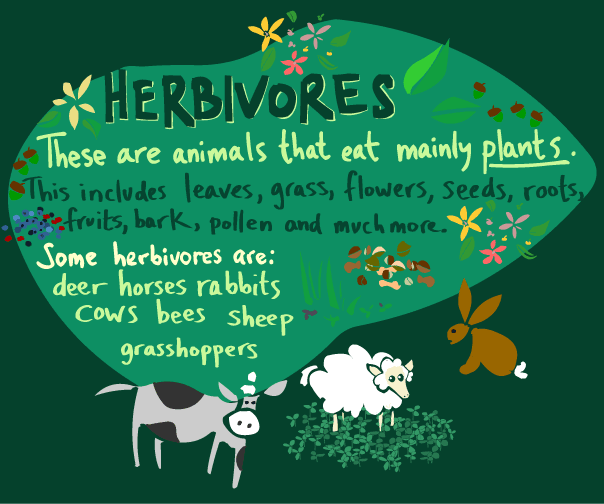
e)  Fungi, like mushrooms, mould and yeast, can make their own food. ________
f)    We can use yeast to make yoghurt. __________
g)  Algae and plants use the light from the Sun to produce their own food.  _________
h)  Animals must eat plants or other animals. _________
5. Write 3 different unicellular organisms and the kingdom they belong to.
6. Draw any living thing and write to which kingdom it belongs to.